Introduction: The story of wireless technology has always been about overcoming limitations. From the days of massive towers broadcasting signals in every direction, to smart beamforming in 5G, the goal has been the same: direct the right signal to the right user at the right time. Now, a new chapter begins with Reconfigurable Intelligent Surfaces (RIS). Imagine walls, ceilings, or even windows turning into programmable reflectors that guide signals like mirrors of light — this is the story of RIS.
What are Reconfigurable Intelligent Surfaces?
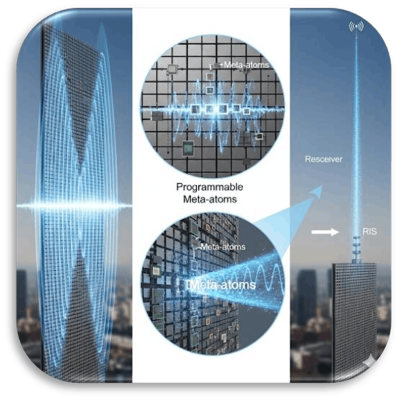
RIS are artificially engineered surfaces built from arrays of sub-wavelength elements (meta-atoms). Each element can adjust its phase, amplitude, or polarization response to incident RF waves. By coordinating these elements, RIS can:
- Reflect signals toward specific directions
- Enhance constructive interference
- Suppress unwanted paths and interference
- Reconfigure beam patterns dynamically
This capability makes RIS a passive yet programmable alternative to conventional active beamforming systems like phased arrays.

How RIS Differs from Traditional Antenna Arrays
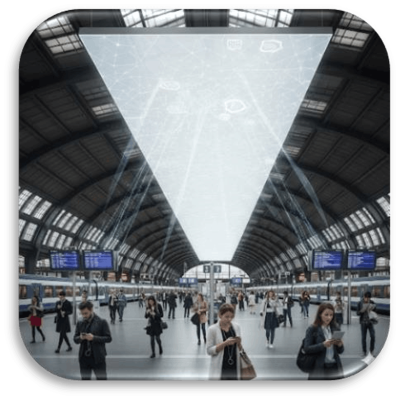
- Energy Efficiency: Unlike massive MIMO arrays, RIS do not require active RF chains at each element, drastically reducing power consumption.
- Scalability: Thousands of RIS elements can be deployed without proportional hardware cost.
- Integration: RIS panels can be mounted on buildings, walls, or indoor environments to improve coverage.
- Flexibility: The same surface can adapt to different frequency bands and communication standards.
The Technical Story of RIS in RF Systems
Think of a RIS as a programmable mirror for radio waves. Here’s how the story unfolds:
- Incident Signal Reception: A wave strikes the surface — like sunlight on a mirror.
- Meta-atom Control: Each tiny unit cell decides how to bend or delay that wave, using tunable components like PIN diodes or varactors.
- Wave Manipulation: The collective behavior of thousands of elements reshapes the wavefront.
- Redirection/Beamforming: The RIS sends the wave precisely toward the intended receiver, rewriting the wireless environment.
Applications of RIS in RF Engineering
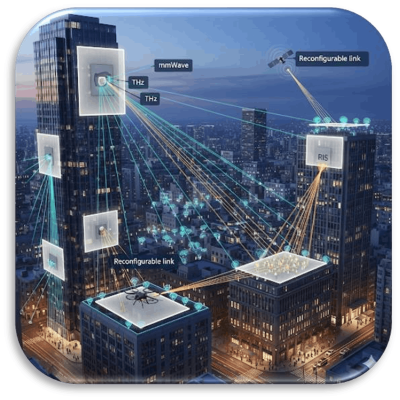
- 5G and Beyond (6G): Enhance coverage in mmWave and THz bands where signals suffer from high attenuation.
- Smart Indoor Coverage: RIS can turn walls into reflective smart surfaces to eliminate dead zones.
- IoT Networks: Low-power communication nodes benefit from RIS-assisted links.
- Satellite and UAV Communications: RIS panels help reconfigure beam paths in dynamic environments.
- Security and Privacy: By controlling multipath propagation, RIS can reduce eavesdropping risks.
Challenges in RIS RF Systems
Every story has its challenges. For RIS, these include:
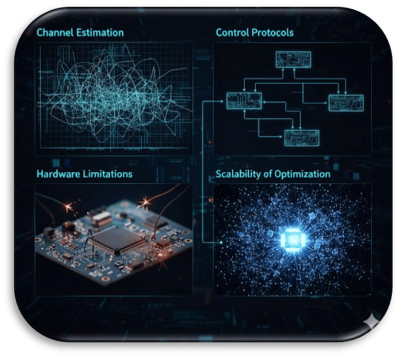
- Channel Estimation: Obtaining accurate CSI (Channel State Information) despite RIS being largely passive.
- Control Protocols: Creating efficient algorithms for fast, real-time reconfiguration.
- Hardware Limitations: Real-world tunable components introduce loss and have limited tuning ranges.
- Scalability of Optimization: Managing thousands of programmable elements simultaneously requires high computational power.
Future Impact on RF Engineering
RIS may redefine the narrative of RF system design:
- Lower dependence on expensive active antenna arrays.
- Enable green communication networks with ultra-low power consumption.
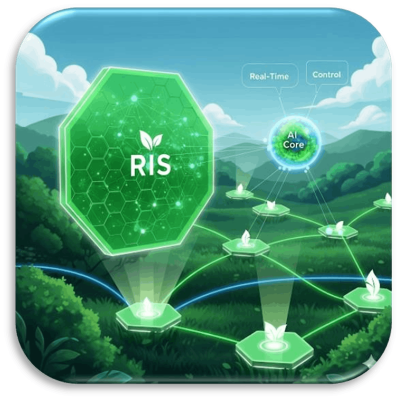
- Merge electromagnetics with AI-driven real-time control.
- Support programmable wireless environments where buildings and infrastructure actively shape communication.
Conclusion
The story of Reconfigurable Intelligent Surfaces (RIS) is about turning the wireless environment itself into a smart, controllable player in communication. By combining programmable metasurfaces RF technology with advanced RF engineering, RIS will drive the next leap in 6G, IoT, and beyond.
Challenges remain, but the narrative is clear: RIS are poised to become the invisible architects of the wireless future.
To continue reading the entire blog