Fidelity CFD Platform
CFD, or Computational Fluid Dynamics, is a simulation-based technique used to study how fluids move and interact with their environment, including changes in temperature and pressure.
By applying advanced modeling tools like the Cadence Fidelity CFD Platform, engineers can analyze and refine systems involving airflow, water dynamics, engine performance, and heat generation. This digital approach streamlines development by cutting down on the reliance on traditional testing methods, saving both time and resources.
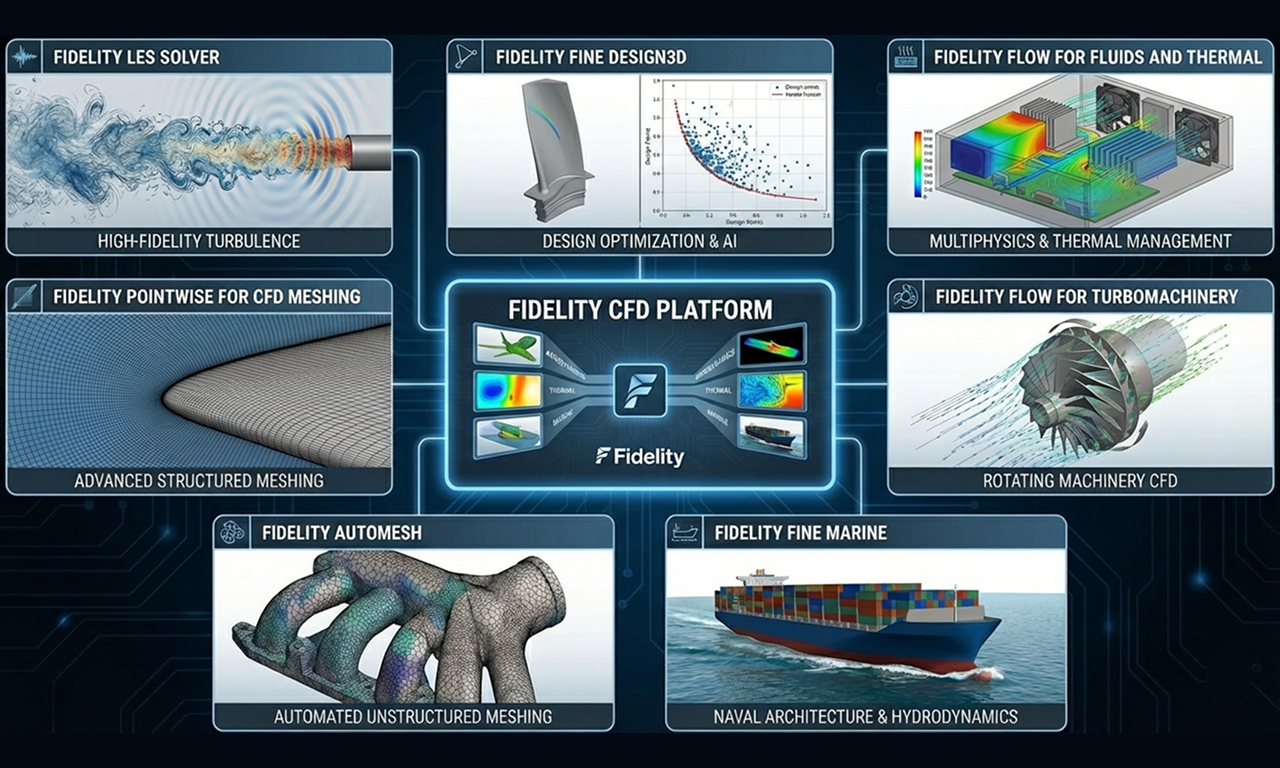
The Fidelity CFD Platform offers a comprehensive and user-friendly solution for fluid dynamics simulation, supporting complex design and optimization tasks across industries like aerospace, automotive, marine, and turbomachinery. Its modern architecture, advanced solvers, and efficient workflows enable high-speed, accurate simulations—helping engineers tackle modern design problems with greater productivity and precision.

Tools
- Fidelity CFD
- Fidelity LES Solver
- Fidelity Fine Design3D
- Fidelity Flow for Fluids and Thermal
- Fidelity Flow for Turbomachinery
- Fidelity Fine Marine
- Fidelity Automesh
- Fidelity Pointwise for CFD Meshing
Applications
Aerospace
Marine
Turbomachinery
Biomedical
Cadence Reality Digital Twin Platform
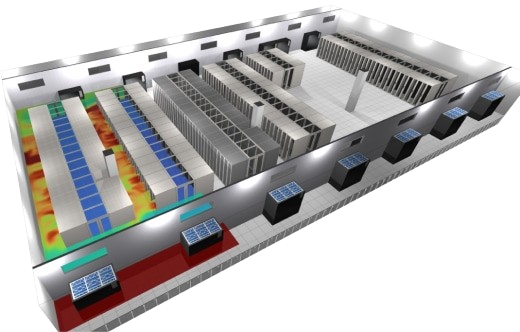
Designing data centers requires CFD simulation to accurately predict airflow, temperature distribution, and cooling efficiency. This ensures optimal thermal management, preventing hotspots and reducing energy consumption.
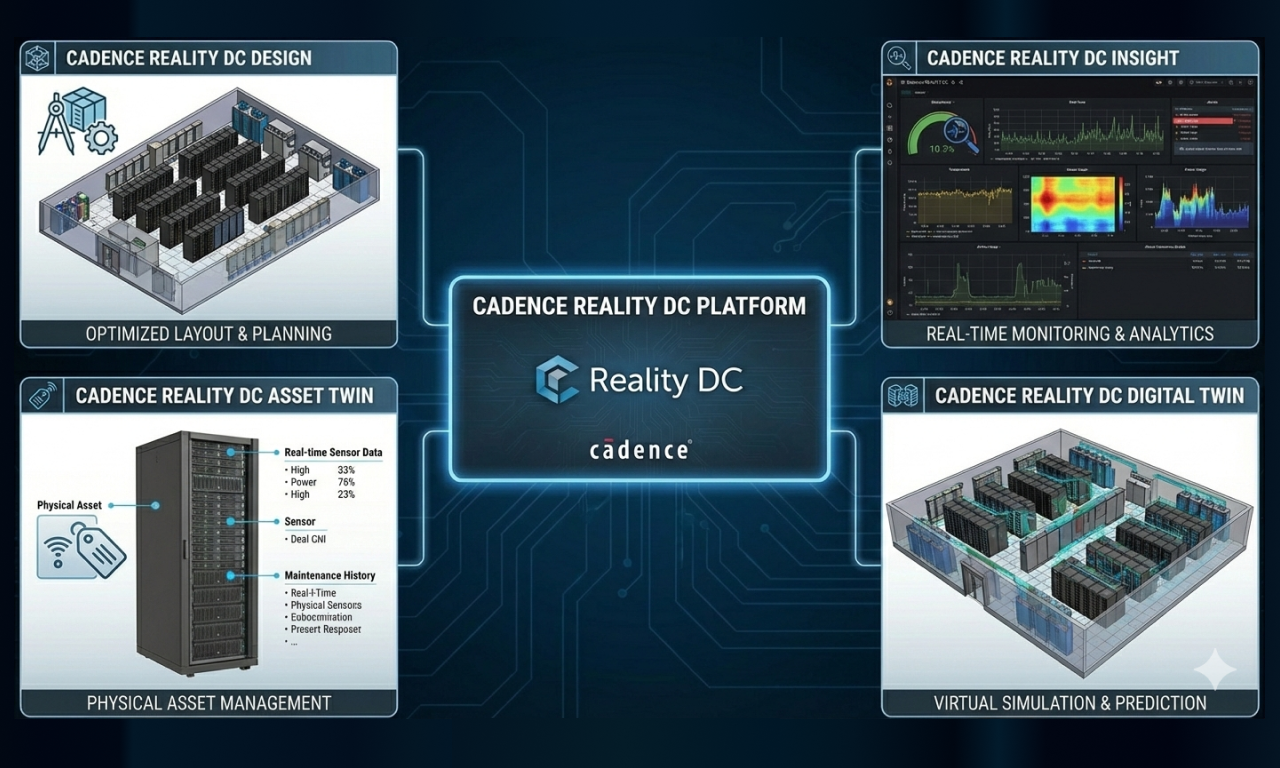
With the Cadence Reality Digital Twin Platform, you're not merely designing or optimizing a data center—you're transforming it. Leverage the unparalleled power of digital twin technology to create performance-driven designs and make insightful operational decisions. Cadence Reality DC empowers you to achieve performance-aware design and operational planning, allowing designers, owners, and operators to balance reliability and efficiency seamlessly. Experience a virtual, easy-to-use environment where innovation meets precision, ensuring your data center operates at its peak potential.
Tools
- Cadence Reality DC Design
- Cadence Reality DC Insight
- Cadence Reality DC Asset Twin
- Cadence Reality DC Digital Twin
Applications
Optimized Data Center Design and Operations
Capacity Planning and IT Deployment
Maximize Data Center Operational Performance
CFD
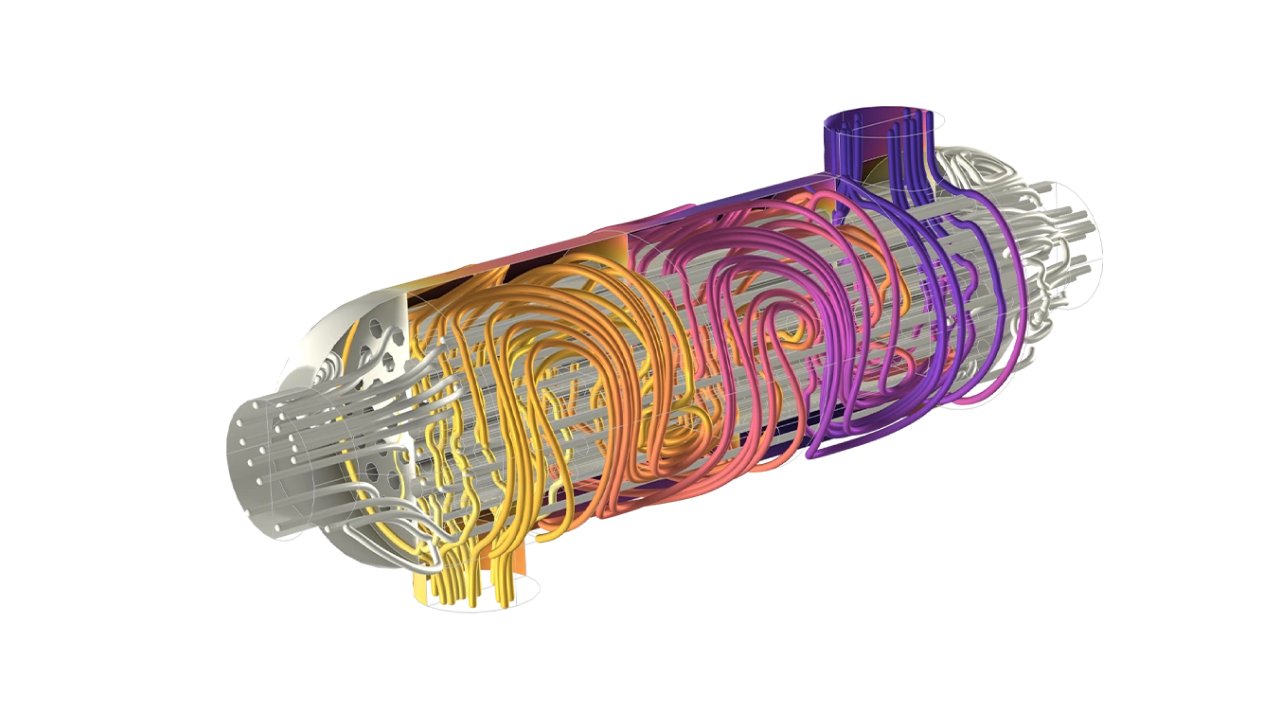
In engineering and design, the challenge is to accurately predict and optimize the behavior of fluids within complex systems—ranging from airflow over aircraft wings to heat dissipation in electronic devices and water flow in piping systems. The problem lies in understanding how fluids interact with structures, how energy is transferred between fluid layers, and how various forces (e.g., turbulence, viscosity, thermal gradients) influence the flow and system efficiency under varying operational conditions. The goal is to simulate and predict these fluid behaviors in a computationally efficient manner, ensuring that the design performs optimally while minimizing energy consumption, material use, and environmental impact.
Solution Summary
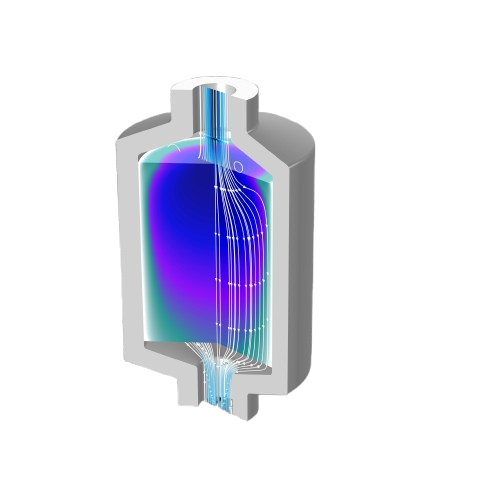
Fluid dynamics plays a pivotal role in optimizing designs for various industries, from automotive and aerospace to energy and HVAC systems. Accurate simulation of fluid flow, heat transfer, and multi-phase interactions ensures that systems are efficient, safe, and optimized for real-world conditions. Our Computational Fluid Dynamics (CFD) solutions provide engineers with powerful tools to model and analyse fluid flow, temperature distributions, and complex thermal effects to enhance performance and reduce operational costs.
Benefits
- Improved Safety and Reliability: Predicts fluid behavior to assess safety and identify issues like turbulence or pressure drops before they occur.
- Cost Savings: Reduces the need for physical prototypes and optimizes performance to minimize operational costs.
- Efficiency in Design: Speeds up development with rapid iterations and simulates complex fluid behaviors.
- Customization and Flexibility: Tailors simulations to specific design needs and adapts easily to changes in design or conditions.
- Better Sustainability: Optimizes energy use and reduces environmental impact, contributing to greener operations.
Our Approach
How it Works
-
Define the Problem
- Identify the system or component subjected to fluid flow, including operating conditions (inlet/outlet flow, temperature, pressure) and fluid type (air, water, oil, gas).
-
Create a Model
- Define the geometry of the system to simulate fluid flow, using a 2D or 3D representation.
-
Apply Boundary Conditions
- Specify inlet and outlet conditions, wall boundaries, pressure boundaries, and heat transfer conditions.
-
Choose Analysis Method
- Select appropriate solvers for flow analysis (steady-state vs. transient), turbulence models, and thermal analysis if applicable.
-
Formulate and Solve Equations
- Use the Navier-Stokes equations, continuity equation, and momentum equations to solve for fluid properties.
-
Post-Processing
- Analyze results including velocity fields, pressure distributions, temperature gradients, and critical parameters.
-
Optimize Design
- Refine the design based on CFD results to improve performance metrics such as drag, heat transfer, or fluid distribution.
-
Verify and Validate
- Compare CFD results with experimental data or analytical solutions to ensure model accuracy.
-
Final Design
- Generate detailed reports summarizing CFD results, including visualizations and performance metrics.
Key Features
Fluid Flow Simulation
Simulates fluid flow, analyzing velocity, pressure, and turbulence.
Turbulence Modeling
Offers turbulence models (e.g., k-ε, LES) for complex flows.
Multi-Phase Flow
Supports multiphase fluid simulations with surface tension and phase changes.
Heat Transfer Analysis
Models heat transfer via conduction, convection, and radiation for thermal management.
Combustion Modeling
Simulates combustion processes, including chemical reactions, emissions, and flame dynamics.
Mesh Generation
Provides structured and unstructured meshes, with adaptive mesh refinement for improved accuracy in critical regions.
Fluid-Structure Interaction (FSI)
Simulates fluid-structure interaction, including deformable boundaries and flow-induced vibrations.
Multi-Physics Simulations
Combines fluid dynamics with heat transfer, electromagnetics, and acoustics for complex analyses.
Contact us
For below details
- Technical Specification Details
- Platform Architecture
- Integration Guide
- Case Study Insights
- or more
Email us at
info@trellisign.com